

MediaMedia
Handelsblatt: China’s government will make overseas acquisitions more difficult
The following content is reproduced from the German Handelsblatt weekend edition of December 2/3/4, translated and compiled by Eurasian Consulting GmbH:
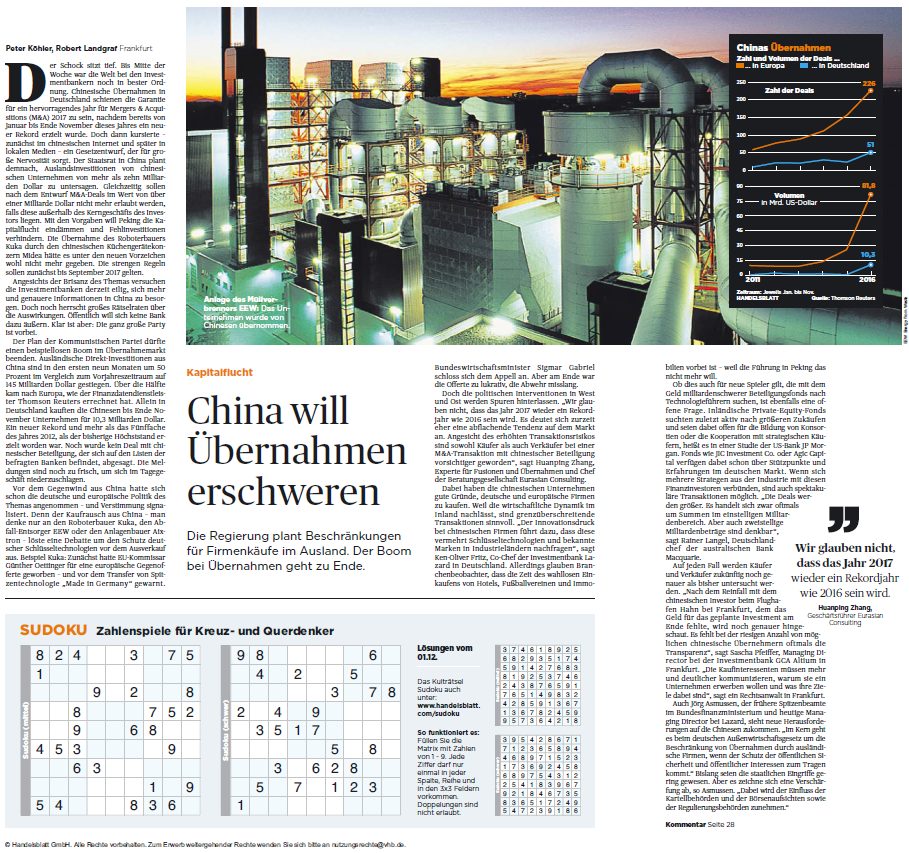
--The Chinese government plans to restrict overseas mergers and acquisitions. The boom in the M&A market will come to an end.
Peter Köhler, Robert Landgraf Frankfurt
The shock is profound. Until midweek, the investment industry remained orderly. Transaction volumes from January to the end of November alone had already set a new record, suggesting that Chinese acquisitions in Germany would make 2017 another extraordinary year for the M&A market. However, rumors of a new bill – initially circulating on the internet and later appearing in local media – sparked widespread anxiety. The State Council of China plans to prohibit Chinese companies from making overseas investments exceeding $10 billion in the future. The bill will also ban non-core business investments exceeding $1 billion. Beijing hopes that this measure will curb capital outflows and prevent poor investments. Under this new policy, the case of Midea, the Chinese kitchen appliance group, acquiring the robot manufacturer Kuka would no longer be possible. This stringent regulation will come into effect in September 2017.
Given the importance of this issue, investment banks are currently eager to obtain more accurate information from China. However, the market is still filled with numerous speculations about the related impacts. Although no bank is willing to comment publicly, it is clear that the party is over.
The Chinese government's plan will bring an end to the unprecedented boom in the merger and acquisition market. Direct overseas investment from China grew by $145 billion, or 50%, in the first nine months compared to the same period last year. According to financial data service Thomson Reuters, more than half of this investment went to Europe. By the end of November, Chinese investors had spent $10.3 billion on purchasing businesses in Germany alone. This is a new high after reaching a historical peak, more than five times the investment in 2012. To date, none of the projects involving Chinese participation that have been surveyed by banks have been rejected. This news is still too new to have affected day-to-day business.
Before resistance emerged from China, Germany and European political circles had already begun to address the issue and expressed dissatisfaction. Chinese purchases—take, for example, the robot manufacturer Kuka, the waste management company EEW, or the equipment manufacturer Aixtron—triggered discussions about protecting German core technologies from foreign sales. In the case of Kuka: first, European Commissioner Günther Oettinger requested the submission of a counter-offer from the European side and warned of the transfer of "Made in Germany" cutting-edge technology. German Economy Minister Sigmar Gabriel subsequently made the same call. However, these defensive measures ultimately failed due to the excessively profitable offers.
Nevertheless, political interventions from both sides will inevitably have some impact. "We do not believe that 2017 will be a record-breaking year like 2016. The market is currently more stable. Given the rising transaction risks, both buyers and sellers are becoming more cautious in acquisition and merger deals involving Chinese investors," said Huanping Zhang, founder and managing director of Eurasian Consulting GmbH.
Chinese enterprises have rational reasons for acquiring German and European companies. Given the slowdown in domestic economic growth, cross-border transactions are a wise choice. "Chinese enterprises face innovation pressure, which necessitates more core technologies and well-known brands from industrial nations," said Ken-Oliver Fritz, co-head of Lazard Germany. However, industry observers believe that the era of indiscriminate purchases of hotels, football clubs, and real estate is over—because the leadership in Beijing no longer wants to see this happen.
It remains unclear whether this bill also applies to emerging market participants who use funds from billion-dollar equity investment funds to seek out tech leaders. In previous research, JP Morgan pointed out that domestic private equity funds are currently actively seeking large-scale targets and are open to forming consortia or partnering with strategic buyers. Funds such as JIC Investment and Hand Capital have already established a foothold and gained experience in the German market. If an increasing number of strategic investors from the industrial sector ally themselves with such financial investors, this could lead to significant transactions. "The deals will be larger. While primarily focused on deals in the several-billion range, deals in the tens of billions are also conceivable," said Rainer Langel, President of Macquarie Germany.
In any case, buyers and sellers will be subject to more detailed scrutiny in the future. "After the disappointment of funds from Chinese investors for an investment plan at Frankfurt-Hahn Airport ultimately not materializing, investors will be scrutinized more seriously. Many potential Chinese buyers typically lack transparency," noted Sascha Pfeiffer, Executive Director of GCA Altium Frankfurt. "Potential buyers must communicate more clearly and explicitly the reasons and objectives for purchasing a company," a lawyer in Frankfurt stated.
Former high-ranking official of the German Federal Ministry of Economics and current executive director of Lazard, Asmussen (Jörg Asmussen), also believes that Chinese investors are facing new challenges. "In essence, the German Foreign Trade Act restricts any foreign mergers and acquisitions that involve the protection of public safety and public interest." So far, state intervention has been minimal. However, Asmussen believes that there are signs of increasing intervention: "The influence from the antitrust authority, the securities regulator, and other regulatory bodies will deepen further."
