The following content is translated from an August 8 report in the German newspaper Handelsblatt:
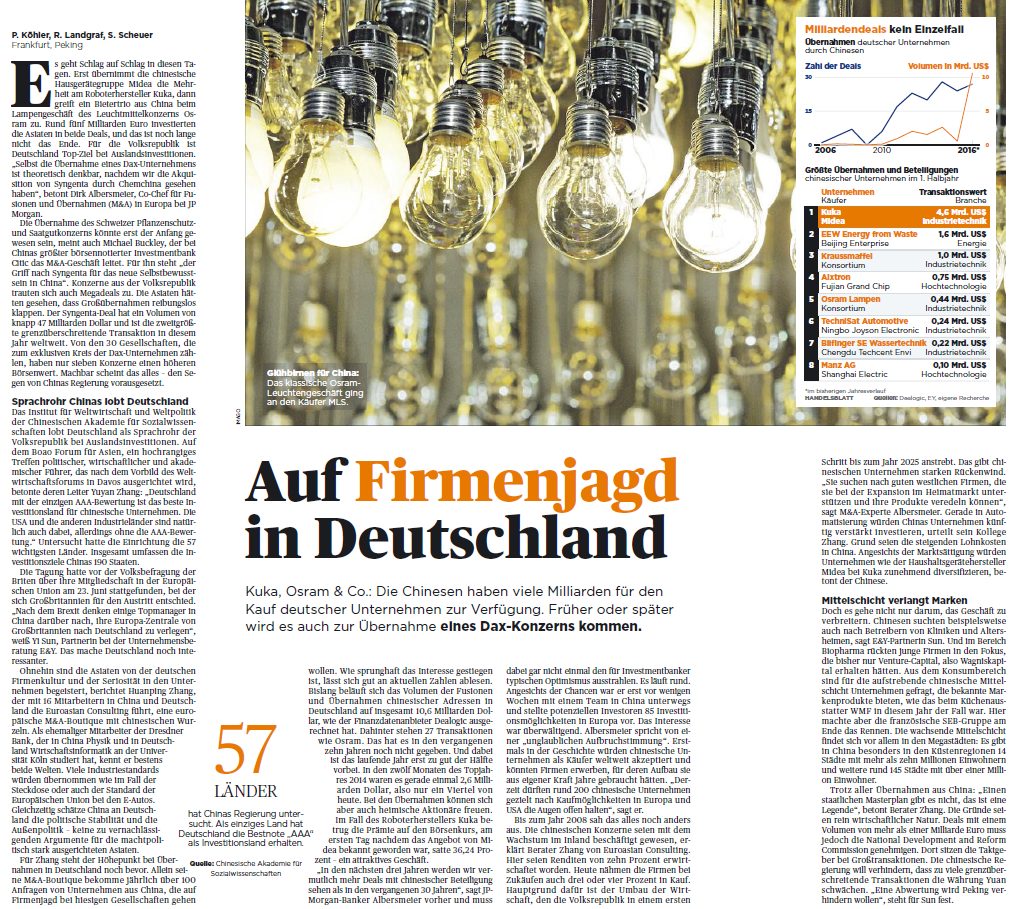
Kuka, Osram, and other cases: Chinese companies have already invested billions of euros in acquiring German enterprises. Eventually, a Chinese company will succeed in acquiring a DAX-listed company.
P. Köhler, R. Landgraf, S. Scheuer
Frankfurt, Beijing
Now, the pace of mergers and acquisitions is accelerating. Just after the Chinese home appliance manufacturer Midea Group completed its acquisition of a majority stake in the robot manufacturer Kuka, news came that another Chinese bidder, MLS, had successfully outbid for the lighting company Osram. In these two transactions, Asians invested nearly five billion euros in total, and this is just the beginning. For Chinese companies, Germany is their top choice for overseas investment. Mr. Dirk Albersmeier, co-head of JP Morgan's European M&A department, said in an interview: "After seeing the successful acquisition of Syngenta by Chinese chemical companies, theoretically, it is possible for Chinese companies to acquire a DAX-listed company in the future."
Michael Buckley, the head of the mergers and acquisitions department at China's largest listed investment bank, CITIC Group, believes that the acquisition of the Swiss agrochemical and seed company is just the beginning. In his view, the successful acquisition of Syngenta has established new confidence in China. Chinese companies are now daring to envision larger-scale deals. Asians have seen this massive project proceed smoothly. The valuation of the Syngenta deal is close to $47 billion, making it the second-largest cross-border merger and acquisition deal globally this year. Among the 30 selected DAX index companies, only seven have a market capitalization higher than this amount. As long as the Chinese government approves, everything seems feasible.
China Praises Germany as Its Spokesperson
The Institute of World Economics and Politics of the Chinese Academy of Social Sciences praised Germany as the advocate for China's overseas investment. Similar to the World Economic Forum in Davos, at the Boao Forum for Asia, leaders from the political, economic, and academic sectors of various countries gathered to discuss the global economic situation. Director Zhang Yuyan of the Institute emphasized: "Germany has the unique AAA rating, making it the best choice for Chinese enterprises to conduct overseas investments. While the United States and other developed countries are also on the list of options, these countries do not meet the AAA rating standard." The institute conducted a rating analysis of the 57 most important countries. Overall, the investment targets of Chinese enterprises include 190 countries.
The forum was held just before the June 23 Brexit referendum in the UK. According to Sun Yi, a partner at Ernst & Young, "After Brexit, some senior executives of Chinese companies have already been considering moving their European headquarters from the UK to Germany." This made Germany more attractive.
Huanping Zhang believes that, regardless of circumstances, Asians highly appreciate Germany's corporate culture and the rigor of its businesses. Huanping Zhang founded Eurasian Consulting GmbH, an investment bank with a Chinese background, which currently has 16 employees in both China and Germany. He majored in physics in China and later obtained a master’s degree in business informatics degree from the University of Cologne in Germany. He also worked at Dresdner Bank, gaining a deep understanding of both Chinese and German cultures. Just as EU standards in the electrical socket industry or the electric vehicle industry are adopted, many EU industry standards are also adopted in China. At the same time, China appreciates Germany's stable political situation and foreign policy—something that cannot be overlooked by politically highly oriented Asians.
Huanping Zhang believes that Chinese enterprises' mergers and acquisitions in Germany have not yet reached their peak. In just one year, his investment bank, Eurasian Consulting GmbH, received inquiries from over 100 Chinese companies, all hoping to acquire German firms with substantial business operations. This growing investment interest is evident from current data, according to Dealogic, which shows that Chinese companies have invested $10.6 billion in German mergers and acquisitions to date, involving 27 transactions, including Osram. This figure has been reached halfway through 2016, which is unprecedented in the past decade. In the prosperous year of 2014, the transaction value was only $2.6 billion, just one-quarter of the current amount. Of course, the German shareholders have also benefited from these transactions. In the case of Kuka, the robotics manufacturer, Kuka's stock saw an attractive increase of 36.24% on the first trading day after Midea announced its acquisition offer. Mr. Albersmeier of JPMorgan stated, "In the next three years, we may see more cases of Chinese enterprises participating in and acquiring companies than in the past 30 years." Facing Chinese entrepreneurs, there is no need to exude the traditional investment banker's optimistic charm; in a roadshow in China a few weeks ago, he presented 85 investment opportunities to Chinese entrepreneurs and received a very positive response. Albersmeier believes that "the storm is coming." Looking back at history, Chinese enterprises as acquirers have gained recognition worldwide. "It is estimated that about 200 companies are specifically targeting M&A opportunities in Europe and America," he said.
Until 2008, everything was different, with large Chinese enterprises focusing on the domestic market, as Eurasian Consulting GmbH's Huanping Zhang put it. Profit margins in the domestic market were then as high as 10%, while those of the acquired companies are now around 3-4%, with a key reason being the central government's goal of transforming the domestic economy by 2025, which has become a driving force behind Chinese enterprises. Albersmeier also stated, "Chinese enterprises are seeking high-quality Western companies, both to support expansion in the domestic market and to upgrade their product lines." Zhang Huanping believes, "Given the rising labor costs in China, Chinese enterprises will strengthen their investments in automation in the future. Saturated markets like home appliances will also prompt more companies like Midea to diversify their risks by acquiring targets similar to Kuka, rather than putting all their eggs in one basket."
The middle class craves brands
However, what is important is not just expanding the business. As mentioned by EY partner Sun Yi, Chinese investors previously sought out businesses such as clinics and nursing homes. In the biopharmaceutical sector, Chinese investors focused mainly on some young enterprises, which had previously only attracted attention from venture capital firms. The consumer goods sector aligns with the needs of the rising Chinese middle class, as these companies can provide branded products. As evidenced by the sale of the well-known German kitchenware and cutlery brand WMF this year, Chinese investors also showed great enthusiasm for this project, although the competition ultimately was won by the French company SEB Group. The emerging middle class is primarily located in major cities: especially along China's coastal regions, where 14 cities have populations exceeding 10 million, and in approximately 145 other cities with populations exceeding 1 million.
Although many mergers and acquisitions now originate from China, there is no top-level design at the national level, according to Huanping Zhang, who believes this is just a myth. This is entirely consistent with natural economic laws. Nevertheless, the National Development and Reform Commission stipulates that projects with transaction amounts exceeding 1 billion euros must undergo approval. This places certain restrictions on large-scale transactions. The Chinese government aims to prevent a decline in foreign exchange reserves due to excessive cross-border mergers and acquisitions. Sun firmly believes: "Beijing wants to avoid currency depreciation."

Merger and Acquisition Checklist
Meetings with senior management
A big stumble! More than four weeks ago, news broke that Frankfurt-Hahn Airport was to be sold to Shanghai Yiqian Trading Company—yet the state government of Rhineland-Palatinate, as the seller, did not receive praise for the deal. Clearly, no one could fully trust the reliability of the Chinese buyer at the time—the transaction price of over 13 million euros never materialized.
This event had a negative impact on the German seller and also tarnished the reputation of the Chinese buyer. However, the errors in this case were actually easy to avoid. Mr. Huanping Zhang, the General Manager of Eurasian Consulting GmbH, said in an interview that the first suggestion is to hire experts familiar with China to conduct background checks on the company through simple public information channels such as the internet or phone numbers. For listed companies, verification is of course easier. Additionally, one can visit the company and attempt to communicate with the company's senior decision-makers.
"Direct communication with executives is always important; middle managers are typically unable to make strategic decisions," Huanping Zhang said. If this had been considered, errors like those in the case of Hahn Airport could have been avoided.
Additionally, the proof of the potential buyer's overall strength is also very important. "To avoid mistakes, the key lies in whether investment banking advisors can uncover clues from financial data. A comprehensive due diligence and risk assessment must also be conducted," said Mr. Dirk Albersmeier, Co-Head of the European M&A Department at US investment bank JP Morgan.
When a company is listed in Hong Kong or has substantial funds overseas, financing is relatively easier.


